What Are Paid Search Ads?
Paid search advertising is a digital marketing strategy where brands pay to display their ads on major search engines like Google, Yahoo, and Bing. Or social platforms like Facebook and LinkedIn.
On Google, they are known as pay-per-click (PPC) ads and can be text ads, display ads, or video ads.
Advertisers bid on keywords and phrases relevant to their business.
The goal?
To appear in the top paid spot of a search engine results page (SERP). For instance:
When people search on Google, text ads can appear above or below the search results. Only up to four ads are eligible to show above the search results.
On social platforms, advertisers target customers based on demographics and interests. When users search those words online, the action triggers a real-time auction with keywords that advertisers bid on.
Let’s say you bid on “organic coffee.” Your Google Ad might appear in the prime spot on a SERP for that search term.

And if you target people on social platforms who expressed an interest in organic coffee, your ad is more likely to appear in their feed.
Each platform uses its proprietary algorithm to determine which ads will appear first. However, there’s more to it than simply outbidding the competition.
Paid search ad platforms use a rating system to measure a campaign’s likely success—for instance, Google Ads has a Quality Score (more on this later).
This score factors in bid amount, ad quality, and landing page quality to determine your ad placement.
Well-crafted ads with relevant content will score higher. And have a better chance of securing a top position.
The main paid search ads platforms include:
- Google Ads
- Bing Ads
- Facebook Ads
- Instagram Ads
- X (Twitter) Ads
- LinkedIn Ads
- Pinterest Ads
- Amazon Ads
Why You Need Paid Search Ads
Using paid search as part of your marketing strategy can increase website visits through paid traffic and organic traffic.
Further reading: Organic vs. Paid Marketing: What Are the Differences?
Relying solely on organic traffic to reach the top of SERPs can take years. Paid ads help you bypass the slow climb and gain more immediate visibility from potential customers. Especially in competitive markets.
And although paid ads don’t directly increase organic traffic in terms of search engine optimization (SEO) rankings, they can indirectly trigger it.
By growing brand visibility and awareness through paid ads at the top of SERPs, you're more likely to see higher clicks on your organic listings as well.
Users who visit your site via paid ads might also return through organic search later. Because they recognize your brand from the ad they clicked on previously.
The Benefits of Paid Search Ads
Paid search ads offer many advantages that can significantly improve your digital marketing strategy results. Here’s an overview of some of the benefits:
Reach Your Target Audience
Paid search ads allow you to address your target audience based on relevant keywords—plus demographics like location, language and interests, and search behaviors.
For instance, Google Ads allows you to create various audience segments.
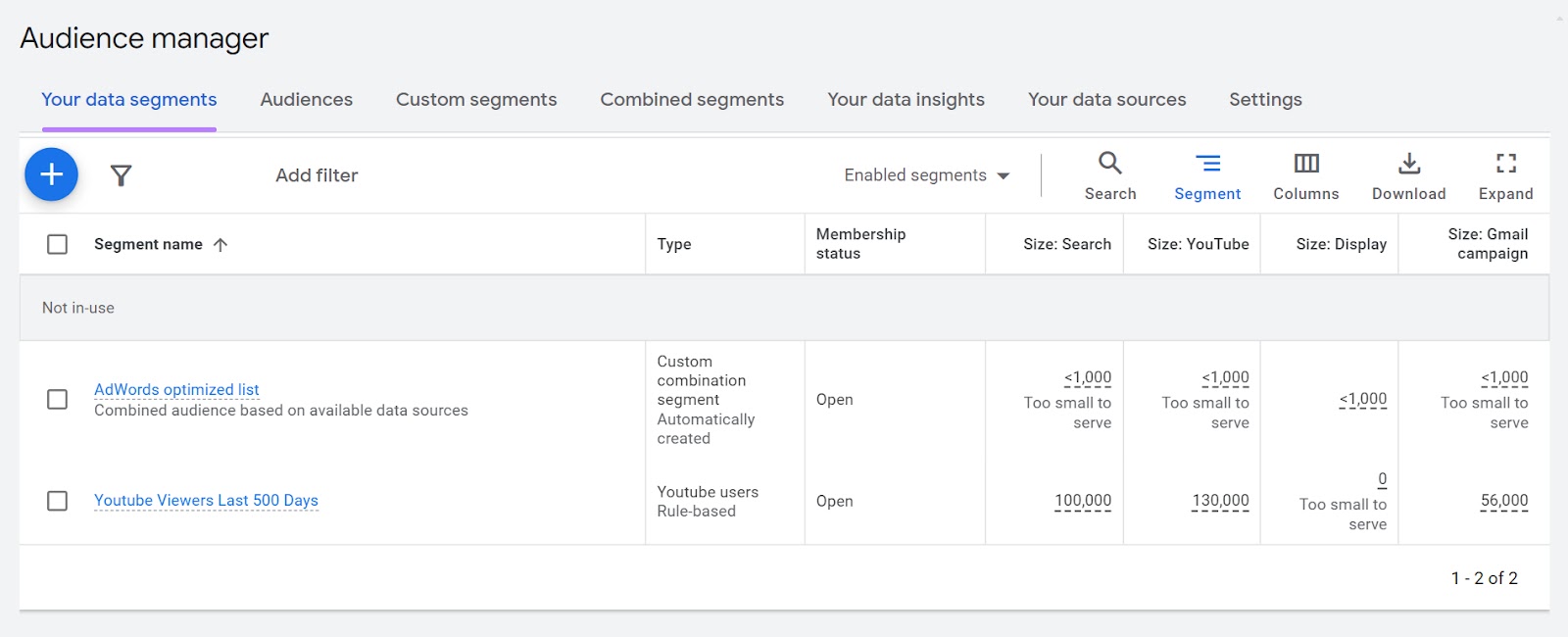
With this level of precision, your ads stand a better chance of reaching those most likely to engage with your brand. Resulting in more qualified website traffic—and improved conversion rates.
Further reading: Conversion Rate Optimization: 9 Tactics That Work
Cost-Effectiveness
One of the most significant advantages of paid search ads is that with PPC campaigns, you only pay when someone clicks on your ad.
This approach offers better advertising budget control. You decide how much to pay for each keyword. And set a maximum daily limit to keep your ad spend in check.
Paid search also increases the likelihood of your spending your marketing budget on customers who may be genuinely interested in your product. Instead of users who are outside your target audience.
Efficient and Immediate Results
Compared to mid-term marketing tactics like social media and long-term strategies like SEO content, paid search ads can bring in results faster.
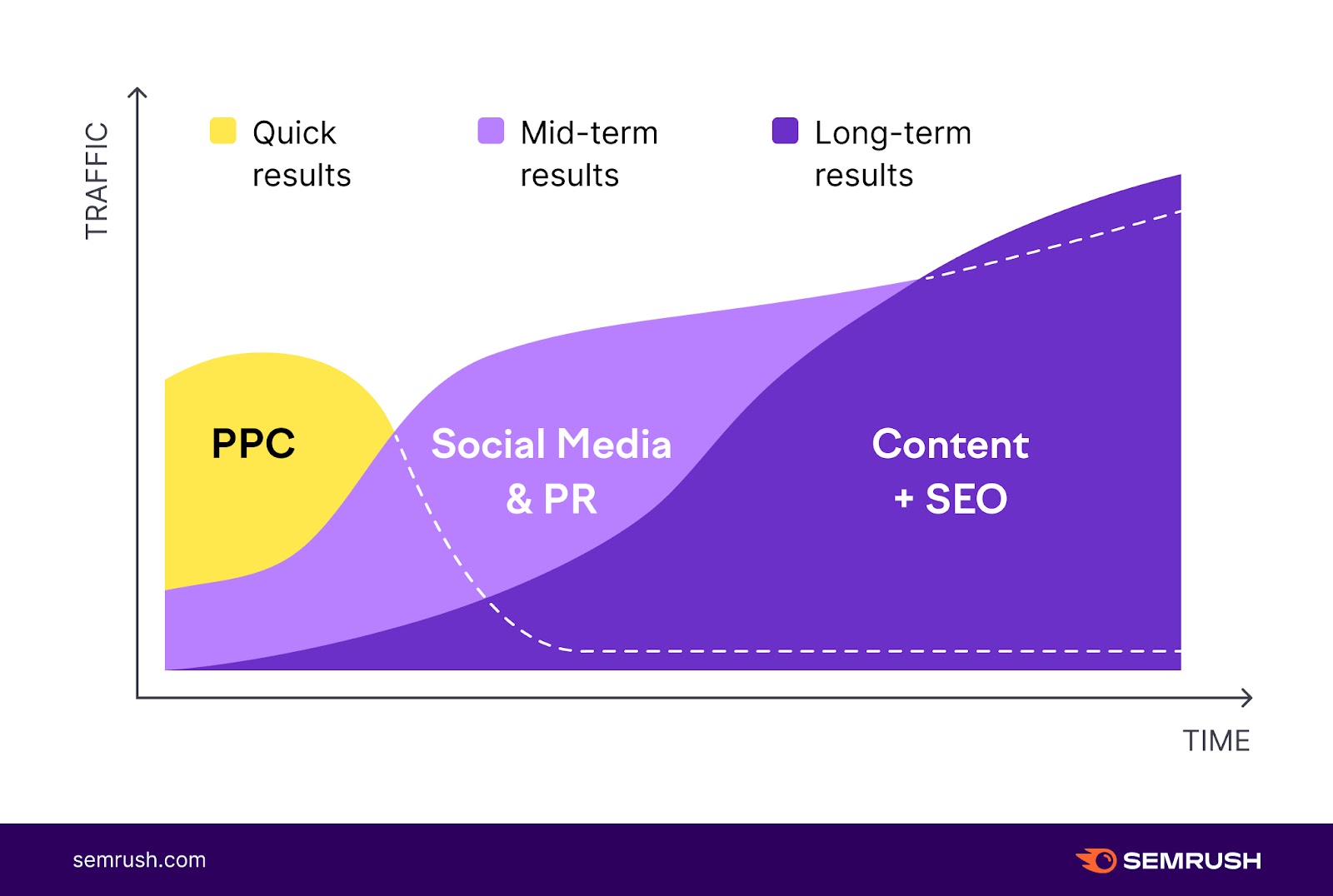
As soon as your ad campaign goes live, your ads should appear in search results and drive instant traffic to your site. Which is especially critical for time-sensitive promotions or when testing new marketing strategies.
The best part is that every aspect of a paid search campaign is measurable—from the number of ad clicks and impressions to conversions and return on investment (ROI).
The data helps you understand what you’re getting from your investment. So you can make informed adjustments to your ad campaigns.
The Market Dictates the Ad Price
Market demand and the resulting competition for specific keywords are what determine the cost of paid search ads.
For example, if the search term “organic coffee” is highly competitive, you may want to bid on a similar phrase with lower competition. It will help keep your ad costs down while still attracting your target audience.
One way to find lower-cost keywords is by using a keyword research tool like Semrush’s Keyword Magic Tool.
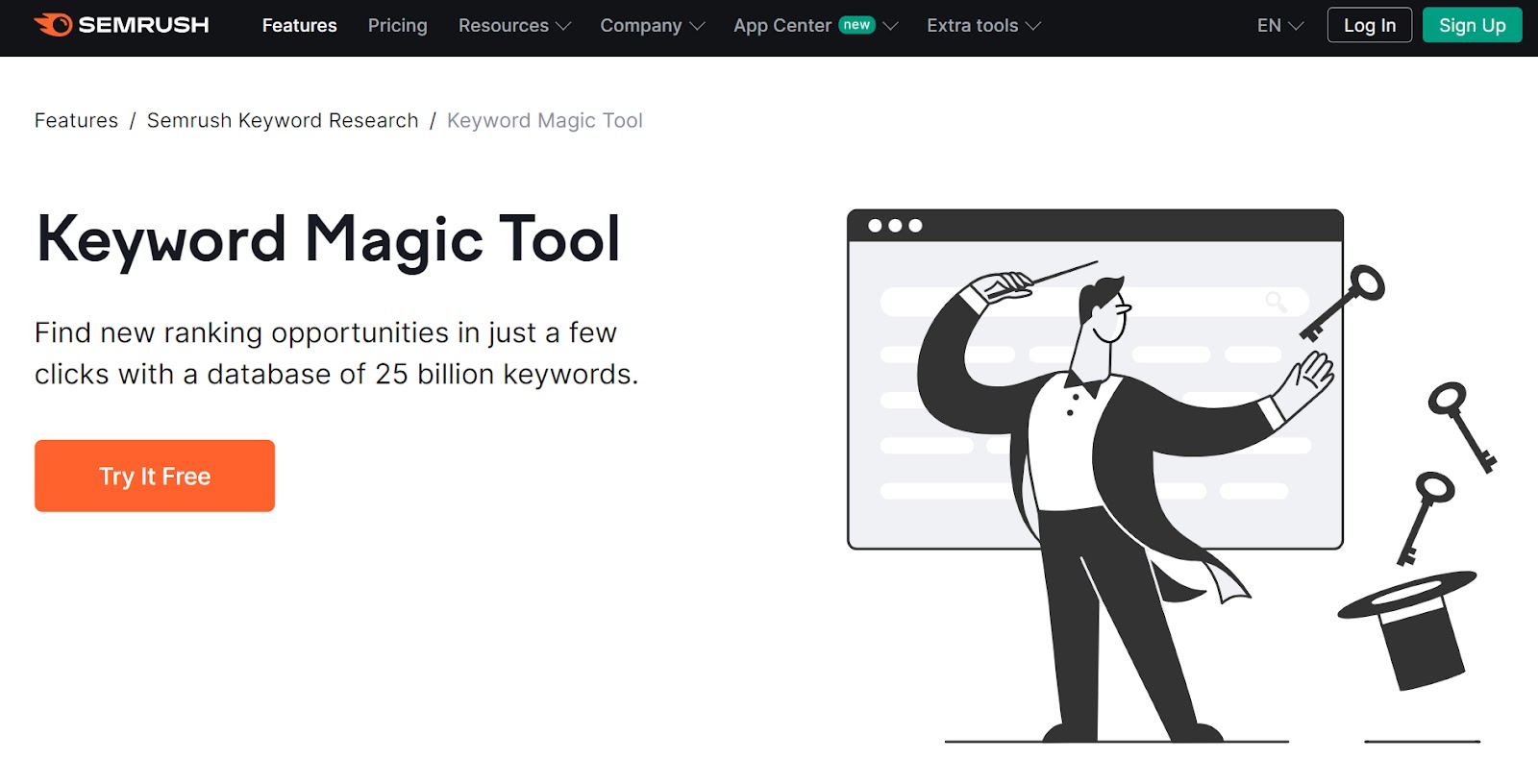
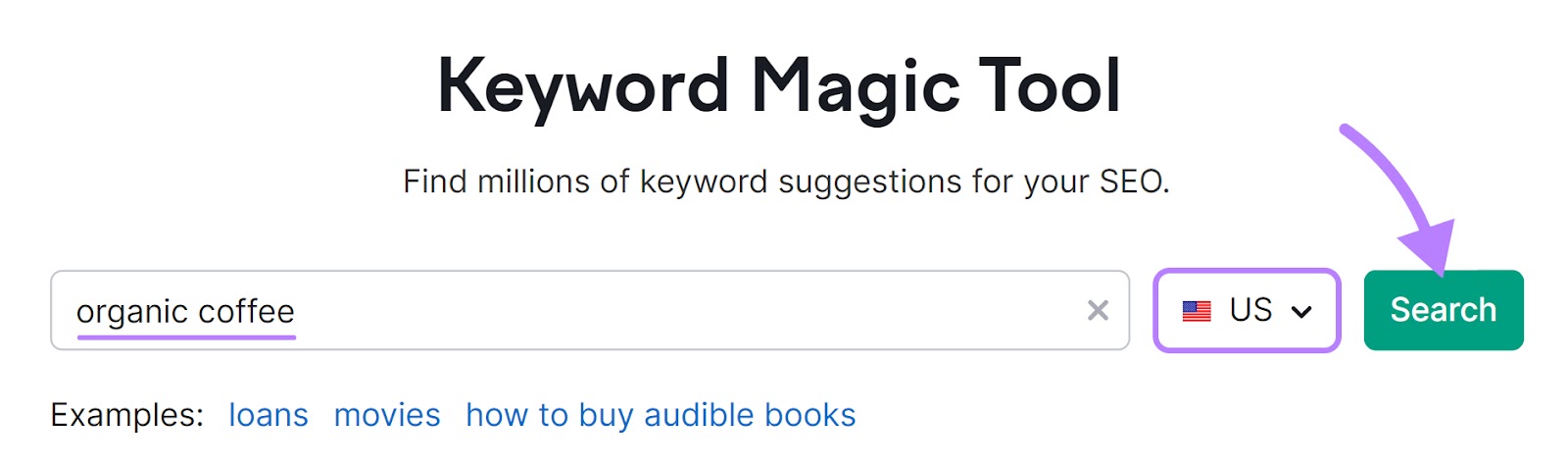
Scroll down the Semrush dashboard menu and click “Keyword Magic Tool.”
Enter the main keyword or phrase you want to rank for. If you have an organic coffee roasting company, type in “organic coffee.” Select the target country for your ad.
Click “Search” and wait a few seconds for your results to load.
The results page defaults to “Broad Match.” Here, you can identify less competitive keywords than “Phrase Match” or “Exact Match.” (We explore keyword match types here.)
The list can include long-tail keywords—longer, more specific phrases.

You may want to refine your keyword search with semantically related keywords (words similar to your main keyword). They help search engines better understand the context of your ad so it has the potential to rank well beyond “organic coffee” searches.
Remember to bid on keywords with the best ratio of low cost per click (CPC) to high search volume if budget is a concern.
To find semantically related keywords for “organic coffee,” click “Related” in the menu bar at the top.
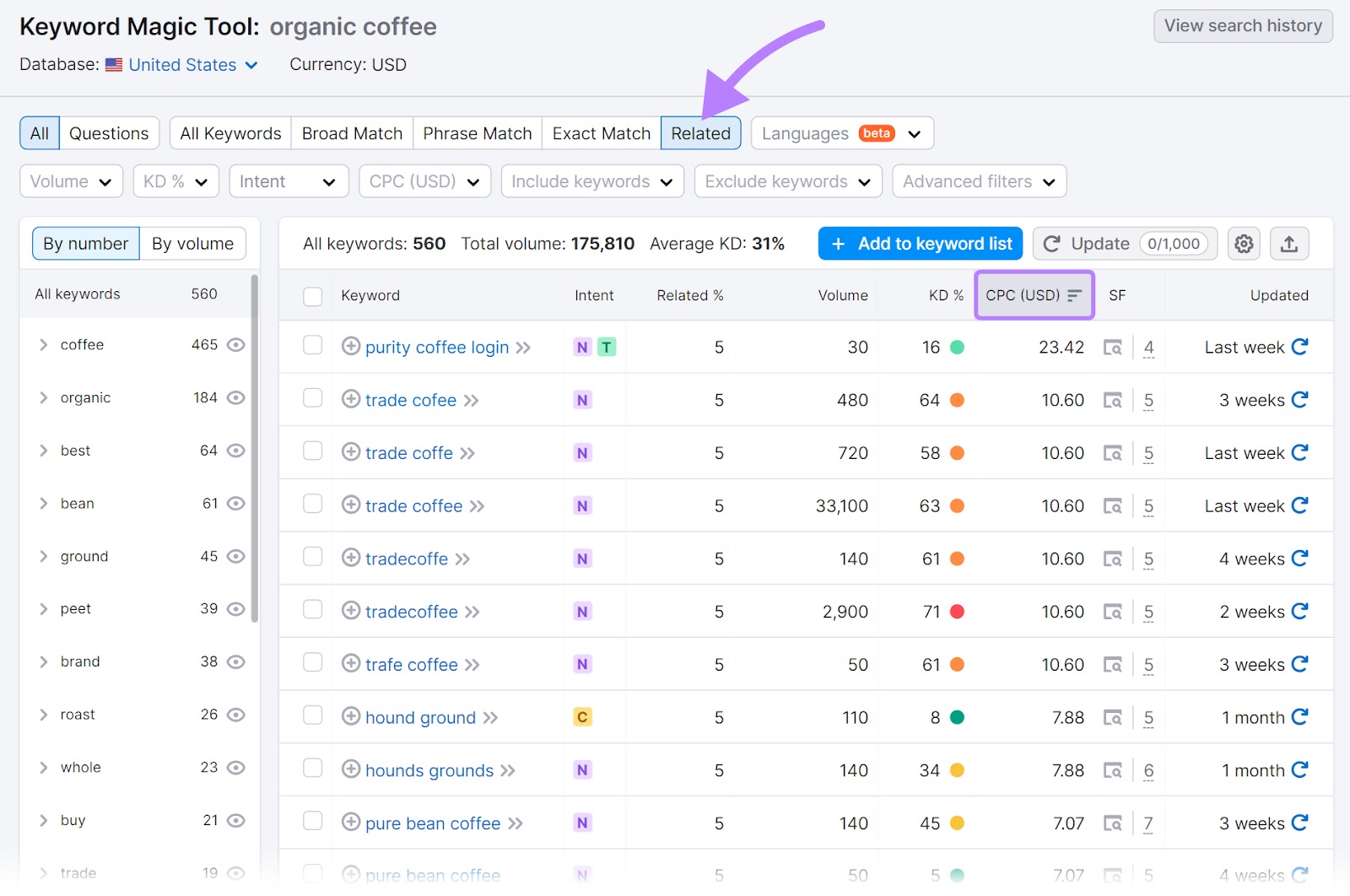
Filter your new list of related keywords from most expensive to least expensive or vice versa by clicking “CPC.” And find the right search terms for your campaign budget.
Paid Search Ads vs. SEO
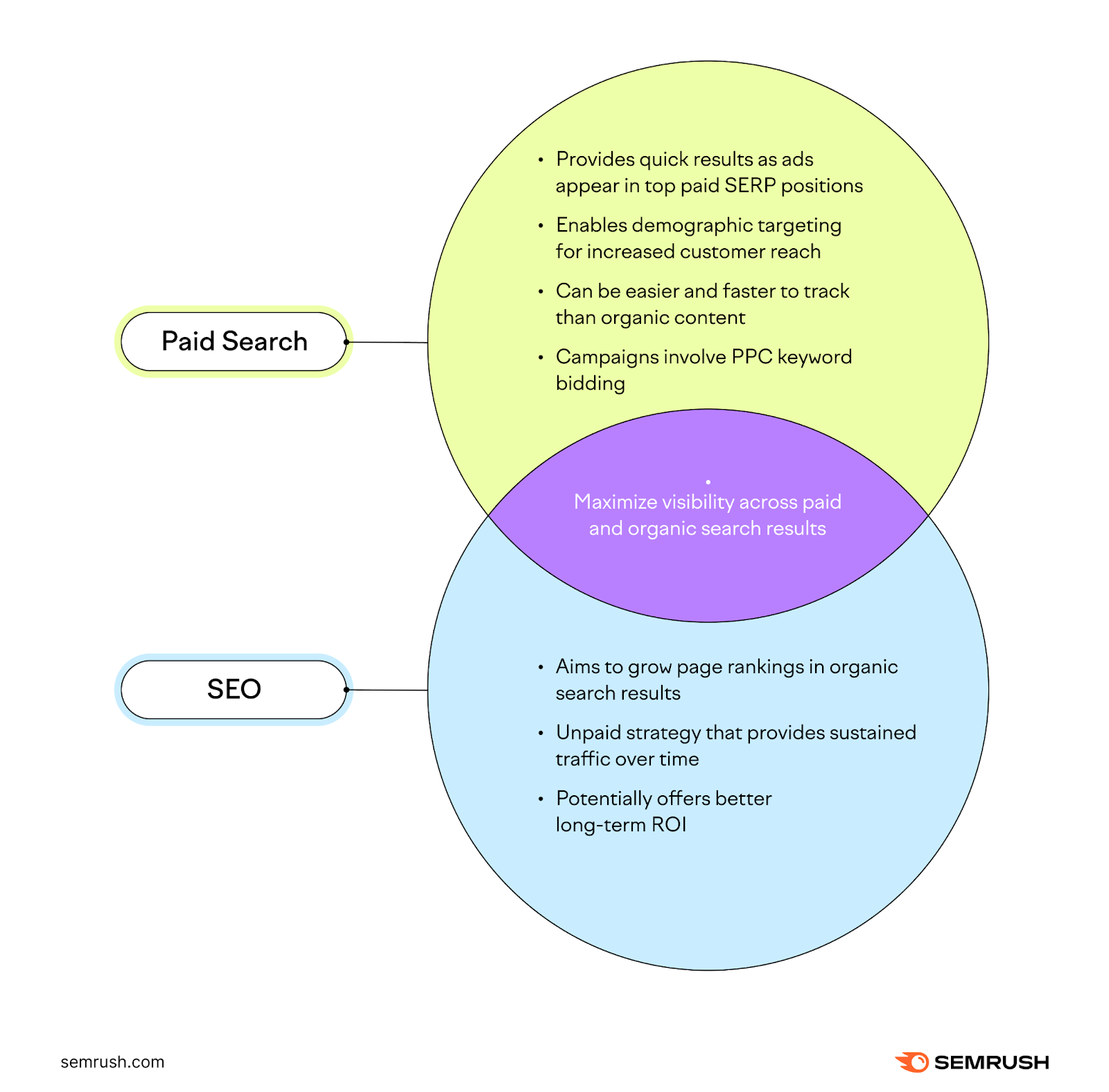
Paid search ads and search engine optimization (SEO) are both critical parts of an effective digital marketing strategy.
While they both increase visibility and drive traffic to your website, they operate quite differently. Understanding these differences is essential to using each strategy effectively.
As we’ve discussed, one of the primary advantages of paid search ads is quick results.
Ads can appear at the top of SERPs as soon as your campaign begins. You have more opportunities to reach potential customers with hyper-specific demographic targeting. Plus, it’s much easier and faster to measure results from a paid ad than to track a blog post’s performance.
On the other hand, SEO focuses on growing and maintaining high rankings through organic search results. It’s a long-term, unpaid strategy that can provide sustained traffic over time.
SEO requires upfront investment, especially for content creation and site optimization. However, because it doesn’t incur costs per click, it can potentially offer better long-term ROI.
Combining both strategies can help maximize your visibility in paid and organic search results.
For instance, keyword data from search ads can provide insights to refine your SEO content strategies. And vice versa.
Let’s say “best organic coffee beans” and “fair trade organic coffee” are performing well and sending traffic to your website. Use this information to create content for your website.
Write blog posts focused on these topics and use these keywords where relevant on your website to attract free, organic traffic.
Or, say you have a blog post titled “How to Choose the Best Organic Coffee Beans” that gets high engagement. You may want to run a paid ad campaign centered around this long-tail keyword.
Paid Search Glossary
Below is a comprehensive list with short descriptions of common paid search-related terms.
| Pay-per-click (PPC) | A form of paid search advertising where you pay a fee each time someone clicks on your ad |
| Cost per click (CPC) | The amount you pay each time a user clicks on an ad |
| Impressions | The number of times an ad appears, regardless of whether users click on it |
| Click-through rate (CTR) | A ratio showing how often people who see your ad end up clicking it. Calculated by dividing the number of clicks by the number of impressions. |
| Quality Score | A metric used by paid search ad systems—like Google Ads and Bing Ads—to determine the relevance and quality of your paid ads and keywords |
| A value Google bases on your bid amount and ad quality that determines your ad placement on a SERP or social platform | |
| Ad auction | An automated process that occurs every time a user performs a search query to determine which ads will appear for that specific query, and in what order |
| The webpage users are directed to after clicking on an ad | |
| Conversion rate | The percentage of users who take a desired action after clicking on an ad, such as making a purchase or filling out a form |
| Ad extensions | Additional information included in your paid ad. Including your business phone number, more links to specific pages on your site, or your business’s location. |
| Google Display Network | Over 2 million websites, videos, and apps that reach more than 90% of internet users with relevant ads. Ads are based on the app or site users view content on or their past online behaviors. |
| Retargeting ads | Targeted ads brands display to users who have previously visited their site |
| Geotargeting | The delivery of different content or advertisements to a user based on their geographic location |
| Bid management | The process of adjusting the bid price for PPC keywords to optimize ROI |
How to Set up a Paid Search Campaign
Now that we’ve discussed what paid search ads are, the difference between paid search and SEO, and a glossary of terms, let’s help you properly set up a paid search campaign.
1. Select Your Location Settings
Setting your location is necessary to target your ads effectively. Start by identifying your potential customers’ location—which can be as broad as a country. Or as specific as a city or a radius around a location.
Tailor your location settings to match your business’s service area. If you operate a brick-and-mortar retail store, it makes sense to target potential customers in the same town.
If you also offer online shopping, create a second set of search ads that target your shipping regions.
2. Choose Your Target Keywords
The right target keywords and phrases are the foundation of a paid search campaign’s success. Conduct thorough keyword research to identify terms your target audience uses when searching for similar products or services.
Keyword research software like Keyword Magic Tool can help you find information on your keyword search volume and competition. Plus group your keywords into relevant themes for more effective targeting and easier management.
An example of grouping your keywords—also known as keyword clustering—might look like this:
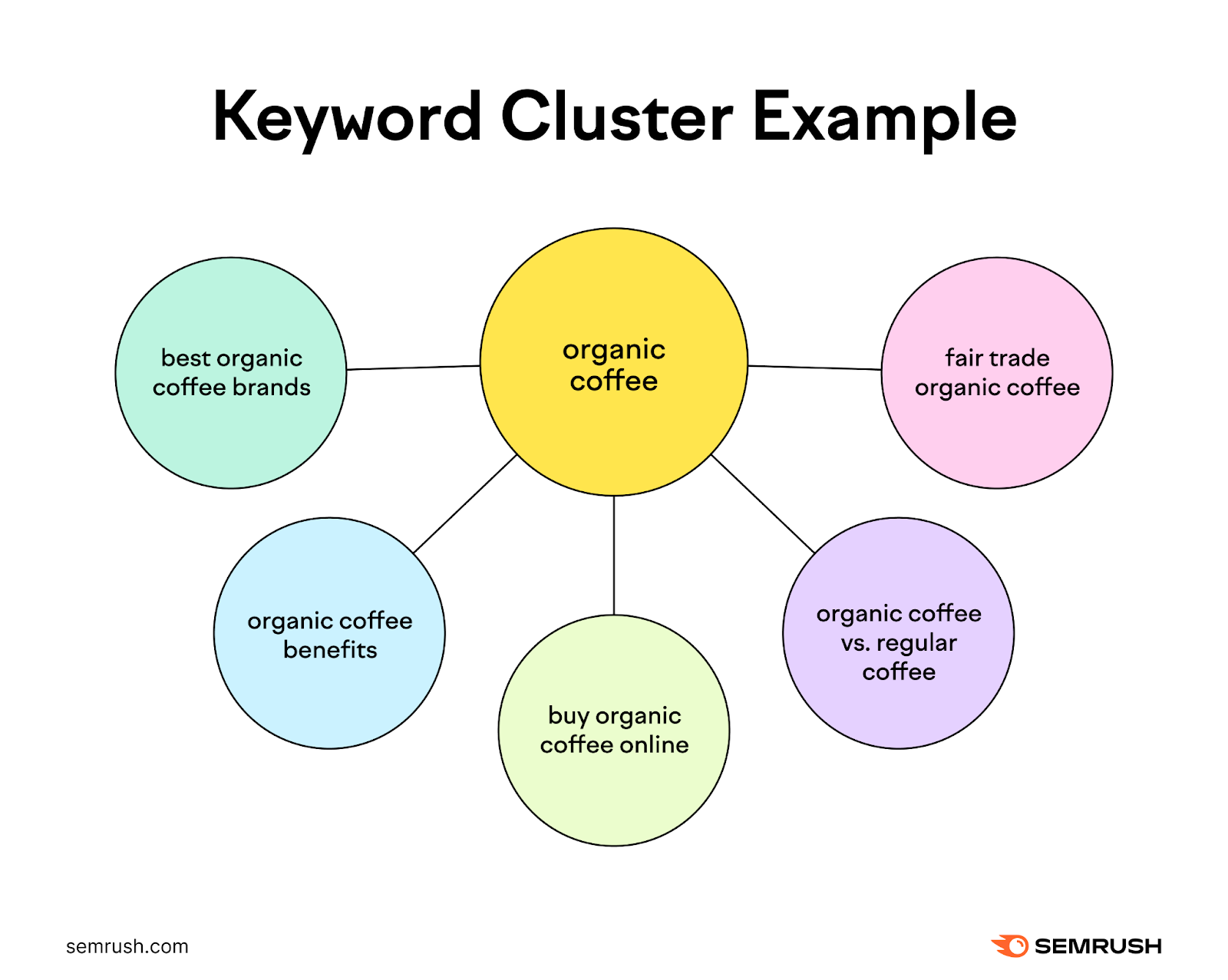
The clustered keywords are variations of or topics related to “organic coffee,” our main keyword example. They represent different user intents and search queries, but all fall under the broader umbrella of “organic coffee.”
Clustering these keywords helps save time and optimize your paid search ads.
3. Determine the Correct Keyword Match Type
Keyword match types determine how closely a user’s search query needs to match your keyword. There are four match types we explore below.
Exact Match
An exact-match keyword offers the highest relevance but the lowest reach in paid search advertising. It targets searches exactly like your chosen keyword or a very close variation.
For example, if your exact match keyword is “organic whole bean coffee,” your ad will most likely appear when someone searches for “organic whole bean coffees.”
But it won’t show for “organic whole bean coffee medium roast” or “medium roast organic coffee.” Limiting its reach potential.
Broad Match
Broad match delivers the most comprehensive reach but the least relevance.
Your ad will appear in a Bing or Google Ads paid search that includes any or all words in your keyword, in any order, along with other terms.
If your keyword is “garden supplies,” your ad might appear for searches like “buy supplies for the garden,” “garden tools,” or even loosely related terms like “garden furniture.”
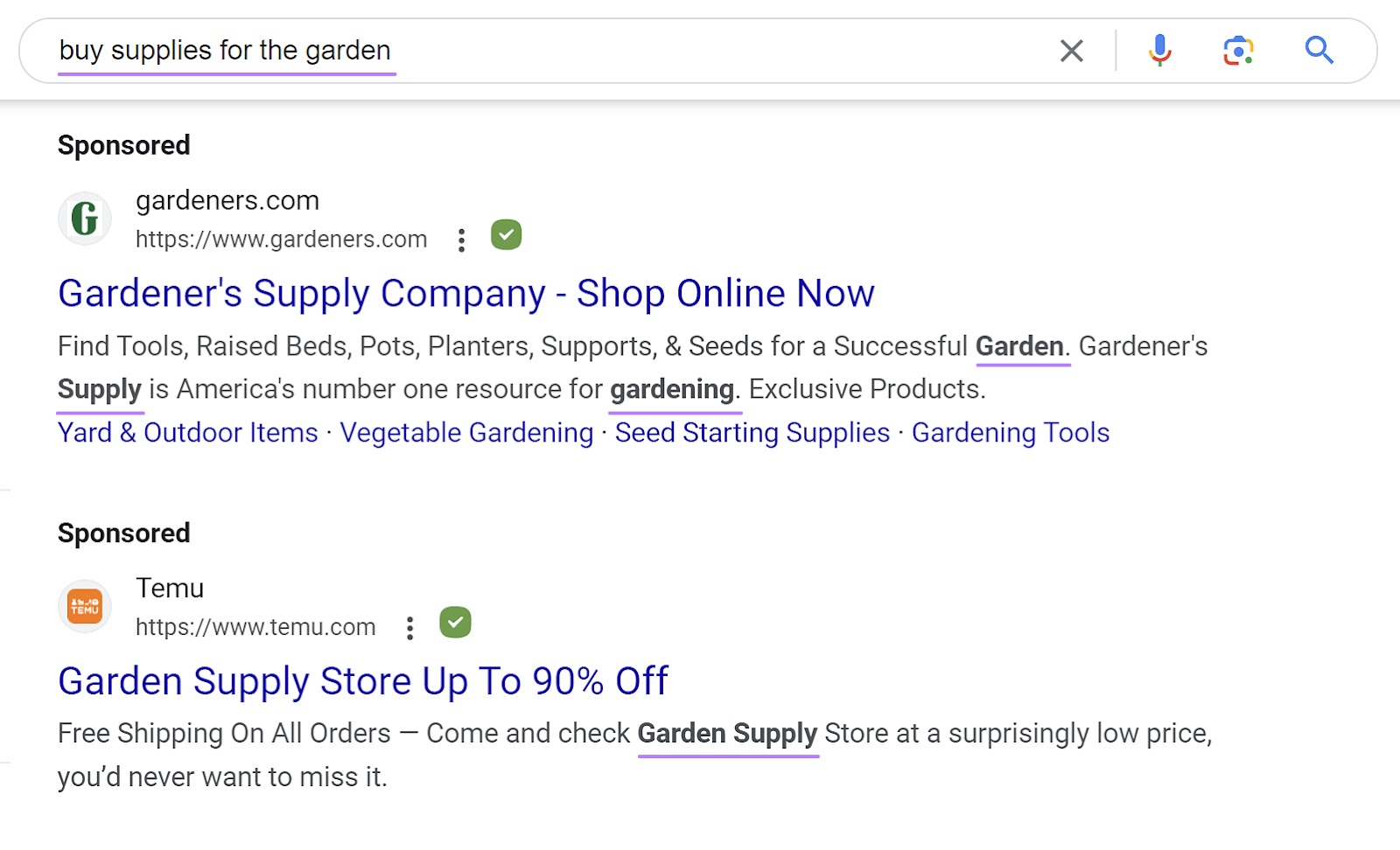
The principle of reaching a wider audience based on keyword relevance extends across various paid advertising platforms, not just Google Ads. Make sure you tailor your use of broad match to each platform.
Phrase Match
Phrase match triggers your ads for relevant searches that cover your keyword’s meaning. Helping you reach more queries than exact match but fewer than broad match.
If your phrase match keyword is “organic coffee beans,” your ad might show for “best organic coffee beans” or “organic coffee beans in bulk,” but not for “beans for organic coffee.”
Modified Broad
Modified broad is similar to broad match but with slightly more control over when and how it appears. It allows you to specify that certain words must be present in a search query to trigger your ad.
Say your modified broad match keyword is “waterproof backpack.” The search query must include both “waterproof” and “backpack,” but in any order and potentially with additional terms.
Your ad, then, might appear for “backpack waterproof for hiking” or “waterproof travel backpack.”
Choosing your keyword match type can therefore impact the effectiveness of your campaign (more on this below under the “Best Practices” section).
4. Create Your Ad
When it comes to your paid search campaigns, it’s in your best interest to put some time and effort into creating an ad that resonates with your target audience and meets search platforms’ requirements. Directly influencing user engagement and conversion rates as a result.
The team at Kadima Digital agrees. According to them,
The primary goal of ad creative is to engage your audience and communicate your brand’s message effectively. To achieve this, ad creative should be visually appealing, memorable, and relevant to your target audience. It should also reflect your brand’s personality and values, as well as the products or services you offer.
Below are a few essential details to consider when crafting your paid search ad:
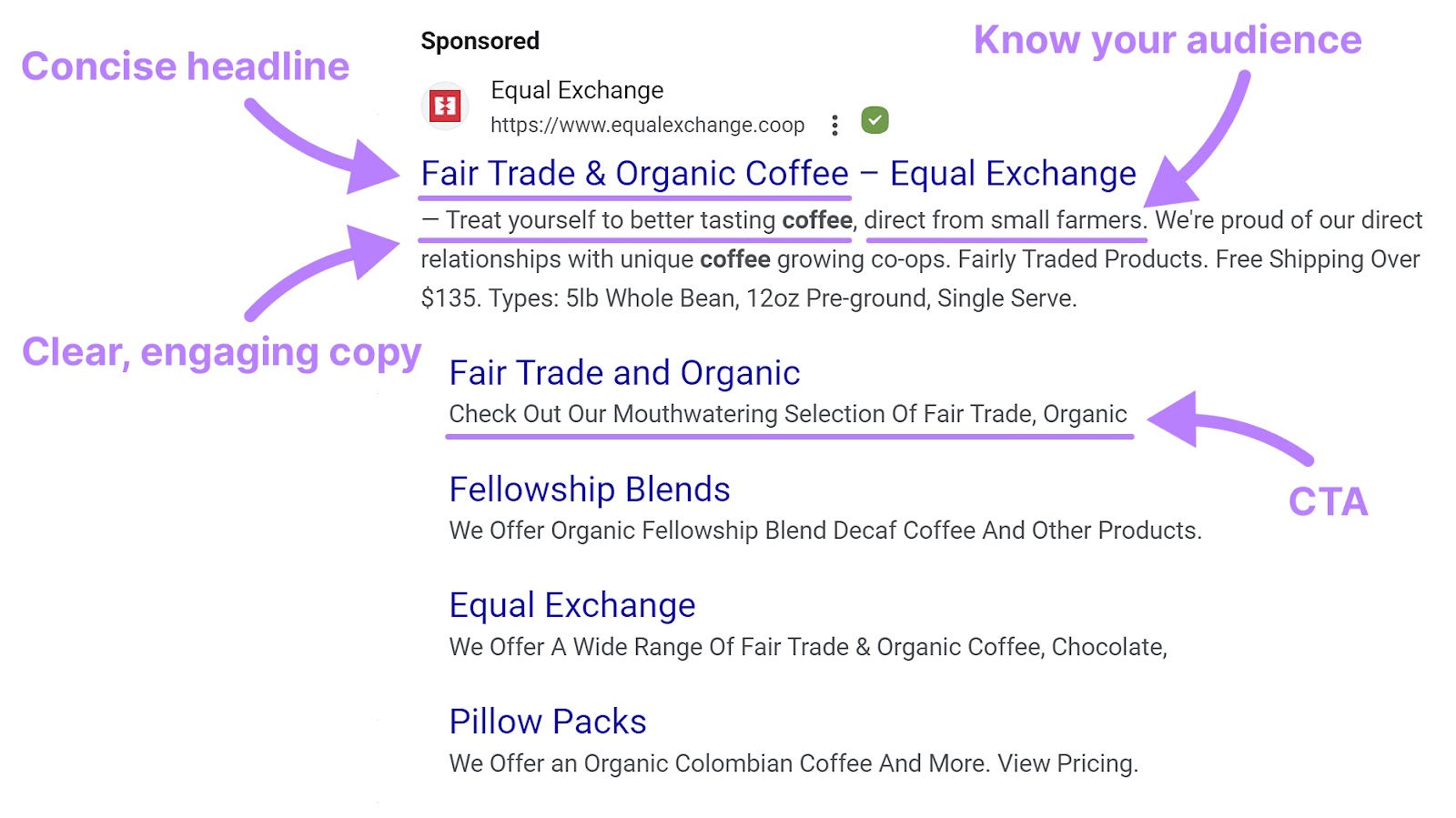
- Know your target audience: Tailoring your message to address their needs, pain points, or desires can significantly increase your ad’s relevance and appeal
- Use visuals that stand out: Whether you create video ads or use still images for your display ads, make sure they stand out enough to catch users’ eyes and stop them from scrolling
- Include a compelling headline: It should be attention-grabbing, concise, and directly related to your target keyword
- Use clear and engaging ad copy: The body of your paid search ad copy should clearly communicate your product or service’s value proposition and benefits
- Include a strong call to action (CTA): Your CTA should be clear and action-oriented, like “buy now,” “click here,” or “learn more”
- Match your ad to your landing page: When users click your ad, your landing page should further communicate your ad’s messaging. This relevance improves user experience and positively impacts your Quality Score—which can lower your CPC and improve ad ranking.
- Stay within character limits: Each platform has its own set of rules and limits for different elements of an ad, such as headlines, descriptions, and extensions. Respect these limits to avoid penalization.
Here are some of the above ad creative tips in action:
5. Refine Your Bid Strategy
There are two types of bid strategies: manual and automated. Choose manual bidding to control how much you pay for each click. Or opt for automated bidding, where the search engine adjusts your bids to get the most clicks and best cost per conversion within your budget.
Most paid search ads platforms will give you a suggested amount to bid. Start with their suggestion or a lower amount that fits better with your budget.
However, remember that a lower-than-suggested bid may affect how well your ad performs. Because bid amount is one of the factors most ad platforms consider when evaluating ad rank. More on this later.
Before you commit to a bid strategy, you may want to research your competition. Here’s where a PPC tool can help you stay ahead of the game.
Use Semrush’s Advertising Research to identify keywords your competitors are bidding on, how much they are spending, which ads are performing well, and why.
To get started, log in to your Semrush account and hover over the “Ad” toolkit in the left-hand menu. Then, click on “Advertising Research.”

Next, enter a competitor’s URL in the search bar. If you’re an organic coffee bean roaster, Starbucks might be a rival. Click the “Search” button and wait for the results to load.
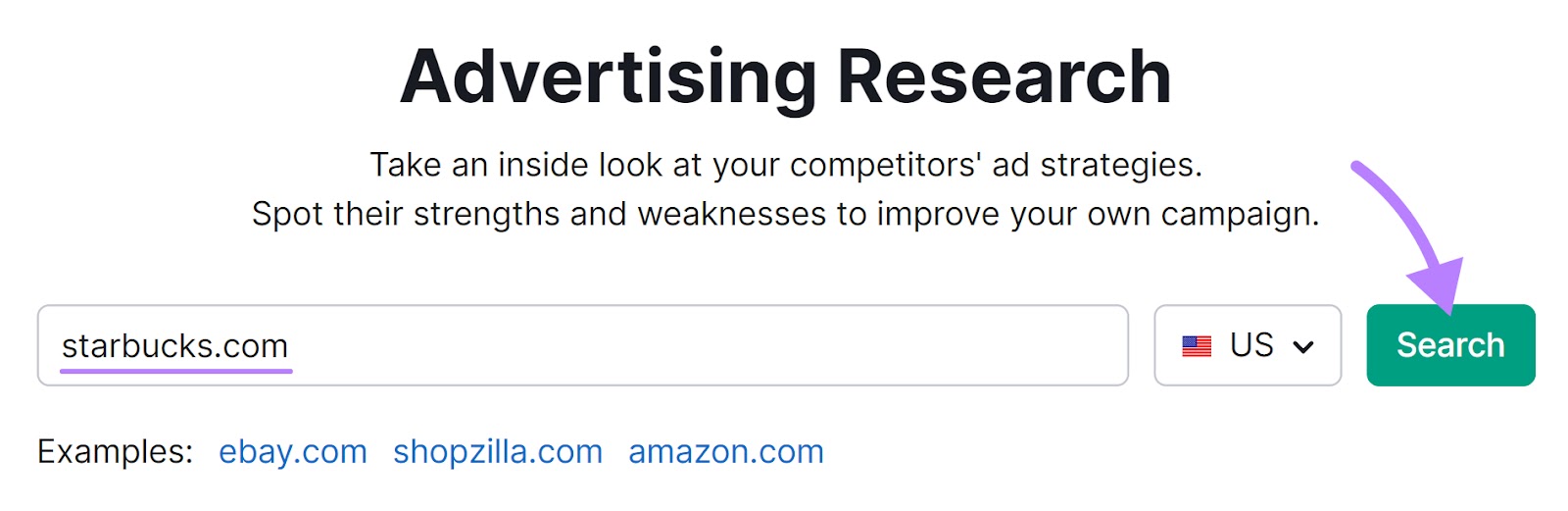
From here, you’ll get an insider look into your business rival’s PPC strategy. Observing what your competitors are doing with their ads can help you figure out how to do it better.
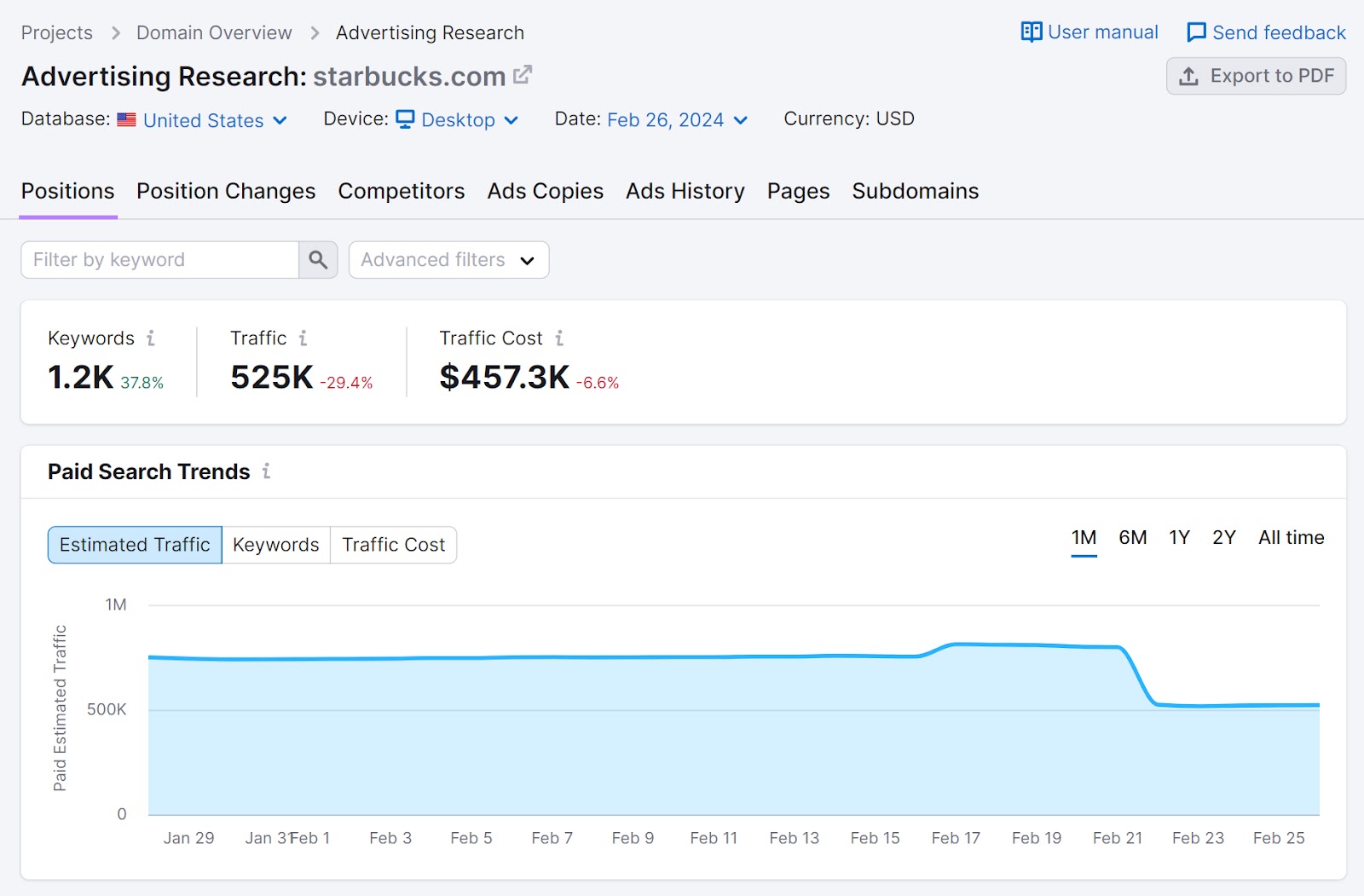
If you scroll down the page, you’ll see which keywords and phrases your competitor currently ranks for, any recent position changes, search volume, CPC, landing page URLs, and traffic per keyword.
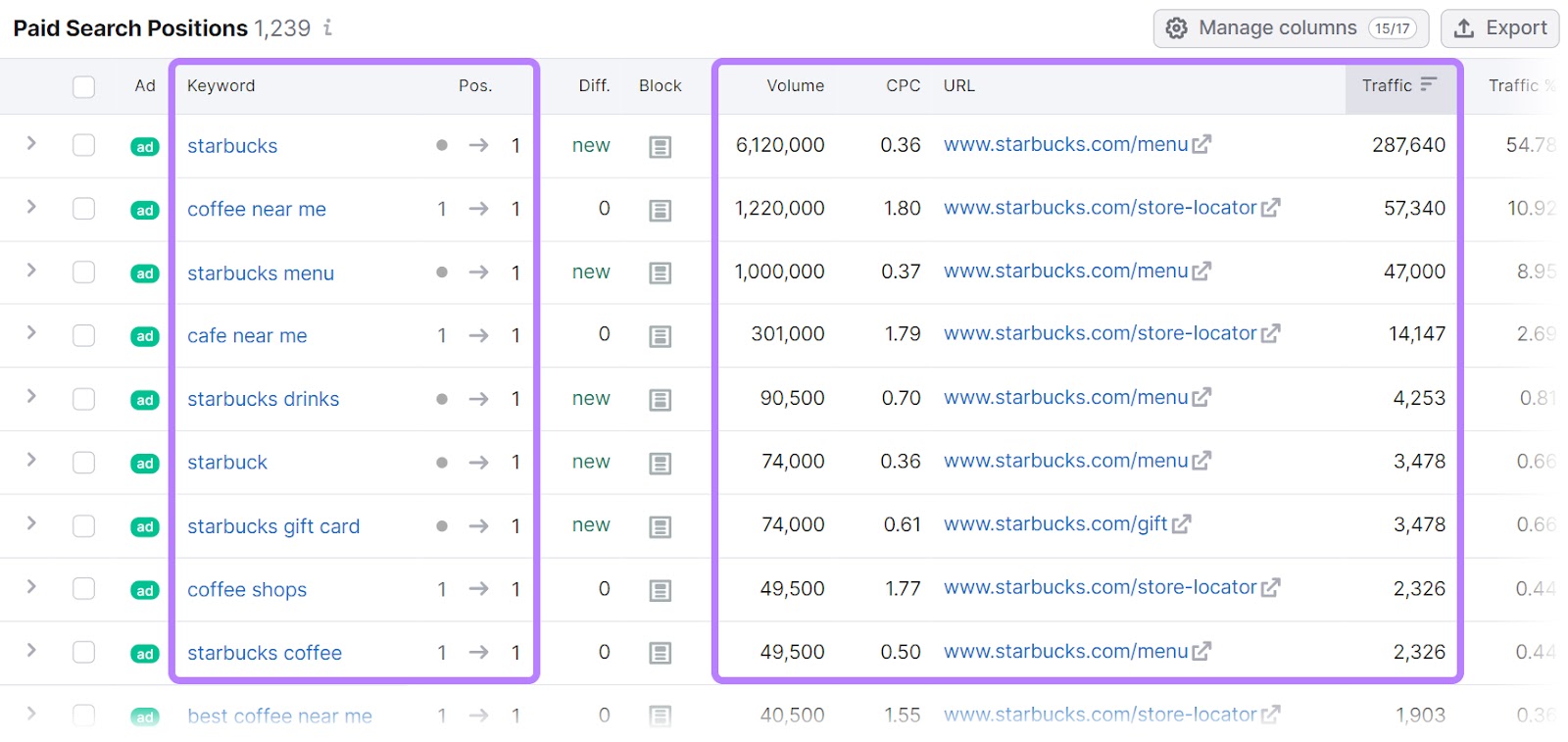
If you click through the navigation tabs across the top, you’ll get a more detailed picture of competing marketing campaigns.
For example, click “Ads Copies” to view current ads and associated landing pages.
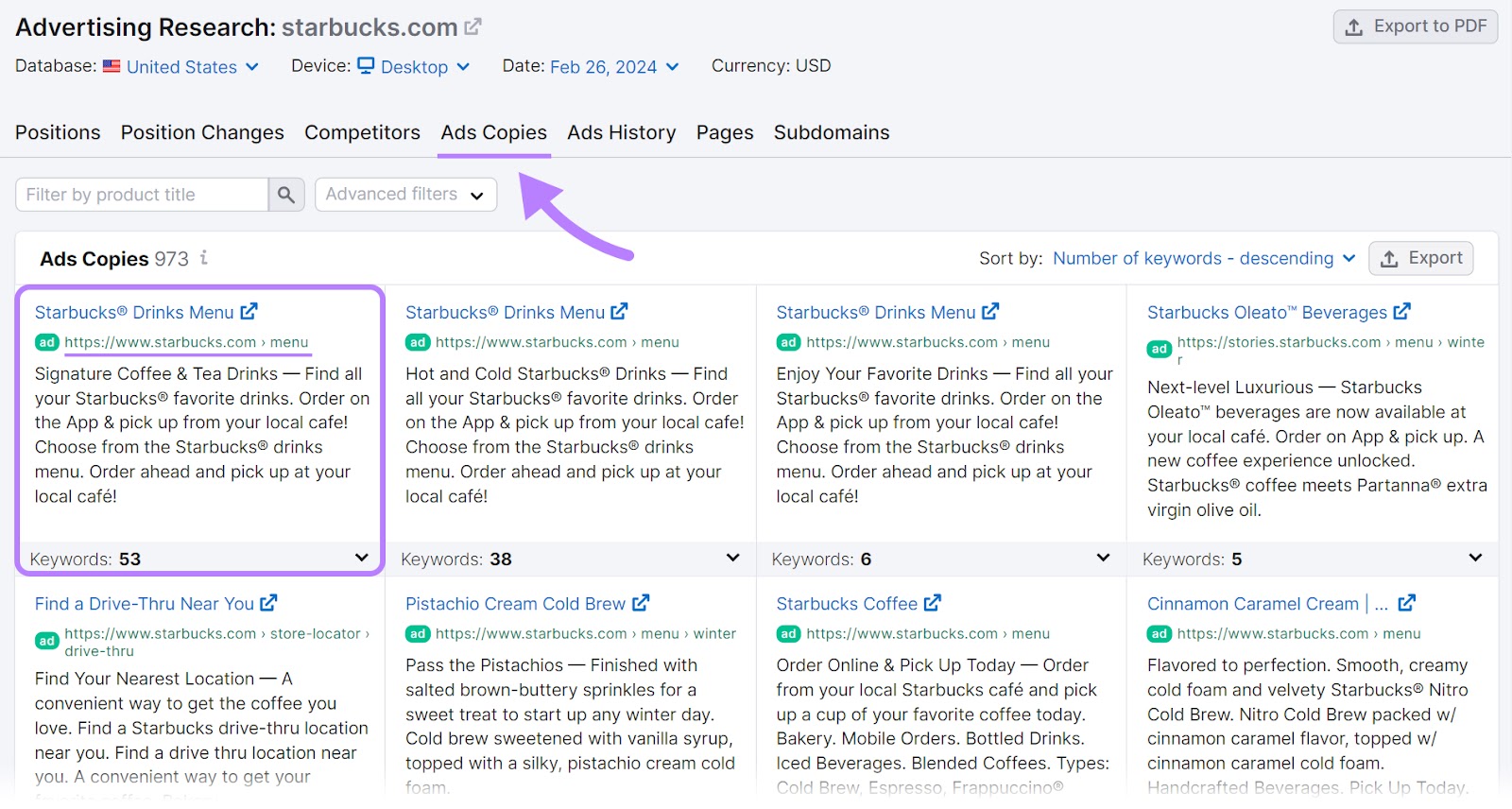
You’ll discover what works well for your competitors and might for you, too. Or where they are potentially missing out on paid traffic.
Spotting these strengths and weaknesses can help you stand out in your market. Is a competitor missing out on a keyword opportunity? Or under-bidding on a keyword that you could outbid them on?
Once you’ve done your homework, design a cost-effective ad campaign with PPC Keyword Tool.
6. Include Ad Extensions
Ad extensions are generally associated with Google Ads. They are free to use and provide additional information and context for online searchers.
Some examples of paid search ad extensions include:
- A business phone number
- A map with your physical address
- Buy now, pay later option
- Images
- 10% off your first purchase
- Free shipping over $60
- Sitelink extensions (a link to another page on your website)
Google Ads reports that including ad assets to your content can increase your ad’s visibility and CTR. Ad extensions are such assets.
Google sometimes automatically includes an extension if it deems it will improve your ad performance. But typically, extensions require manual setup—allowing greater control over the message and information.
The manual setup process involves selecting the extension type within the Google Ads platform, filling out the necessary information (such as specific sitelink titles and URLs for sitelink extensions), and applying them to the appropriate campaigns or ad groups.
A Google search for “best organic coffee” resulted in this ad with multiple ad extensions:
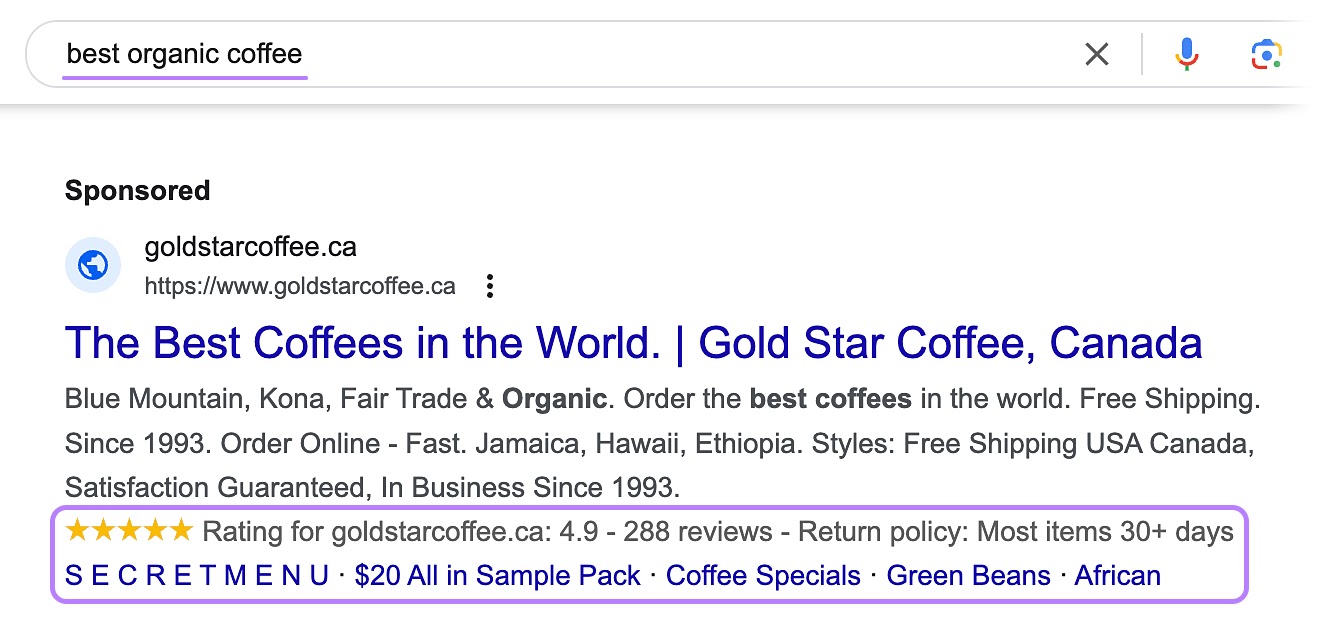
This excellent paid search ad example includes sitelink extensions for a secret menu, a sample pack, coffee specials, and more.
Important: Choose ad extensions that are relevant to your business and helpful to searchers you want to target.
7. Launch Your Ad and Add Billing Information
Before you hit publish on your paid ad, quickly review your search ad campaign settings to ensure you haven’t overlooked anything that could make your ad stand out.
Did you include ad extensions where appropriate? And correctly enter your URL?
After launching, keep a close eye on your campaign performance metrics. Regularly monitor the CTR, conversion rate, and average CPC. It will help you make informed decisions on increasing bids, adjusting keywords, or tweaking copy for improved ad performance.
You’ll most likely need to enter your billing information at the same time you launch your campaign. Most platforms require a pre-paid balance or a linked credit card to charge when you reach a payment threshold.
Remember to track your ad spend so that it aligns with your marketing budget and ROI goals.
How Do Search Engines Establish Ad Ranking?
Search engines consider multiple factors when determining ad rankings. A successful PPC ad campaign hinges on understanding elements like bidding strategies and the best time to display your ad. We’ll go through the main ones below.
Bid Amount
The price you’re willing to pay per ad click plays a critical role in how you rank. A higher bid amount might help your ad appear higher up in paid search results.
However, it’s not the only ranking factor.
For example, if you bid $2 for the keyword “organic whole bean coffee,” your ad might appear above others who bid less for the same term. But if your Quality Score is below average, you may still get outranked.
Ad Extensions
Google Ad extensions enhance your ad with helpful surplus information. Additional product images or links to an end-of-season sale can increase your ad’s appeal.
And ads that get more clicks will often rank better and cost less.
Quality of Ads and Landing Pages (Quality Score)
Factors that affect Quality Score include your ad’s CTR, relevance to the search query, and the relevance of your landing page.
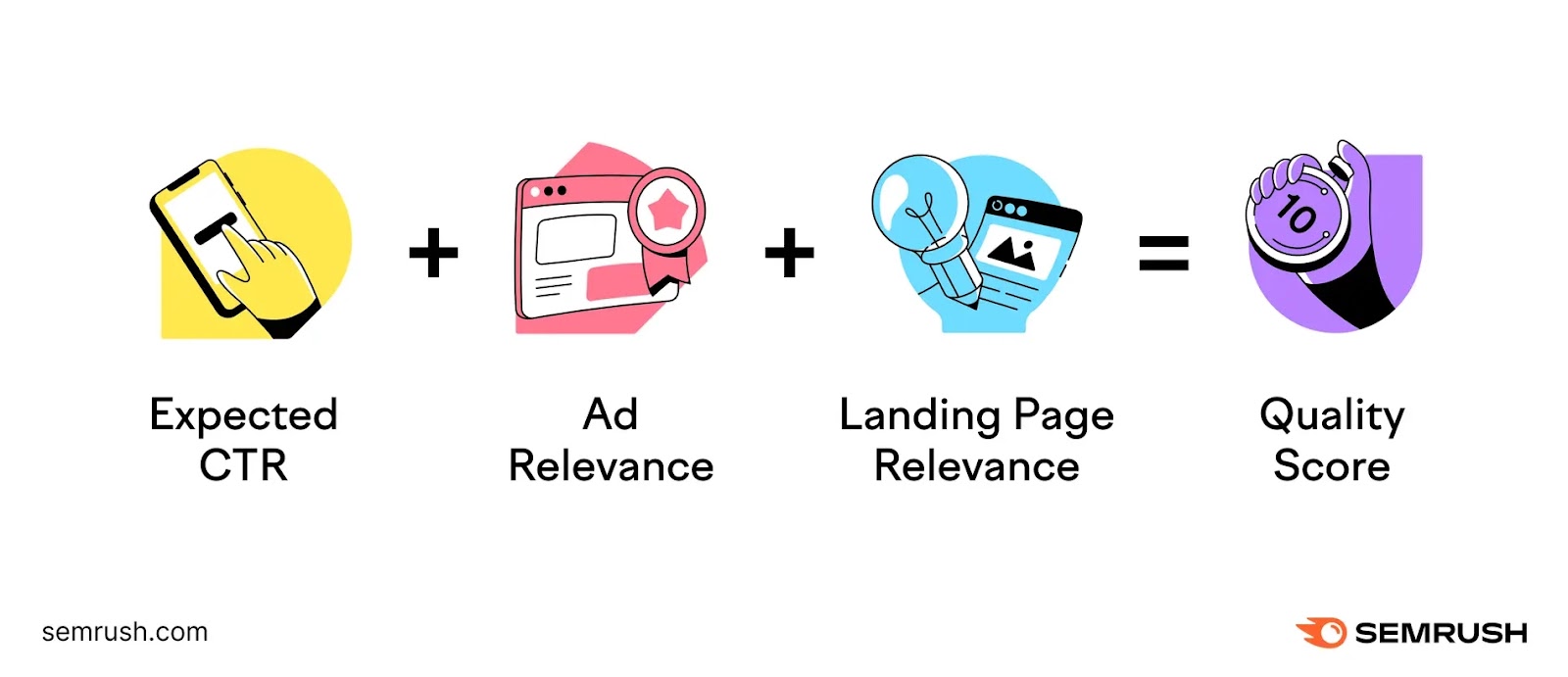
A high-quality ad with an informative landing page relating to it will score better—and typically rank higher and cost less per click.
From a consumer perspective, nothing is worse than clicking on an ad expecting one thing and landing on a completely unrelated page.
Say your ad promotes a 10% off coupon for your organic coffee blend. Then your landing page should mention the discount coupon and showcase that specific product. Don’t direct users to your homepage or any other page that doesn’t mention your ad’s key features and talking points.
Use and Frequency of Keywords
Ads containing keywords that more closely match relevant user queries tend to rank higher in paid SERP listings.
If your ad includes the phrase “vegan skincare products” and matches frequent user searches—e.g., for vegan skincare and vegan skin products—it’s more likely to rank well.
Keywords that Match Search Terms
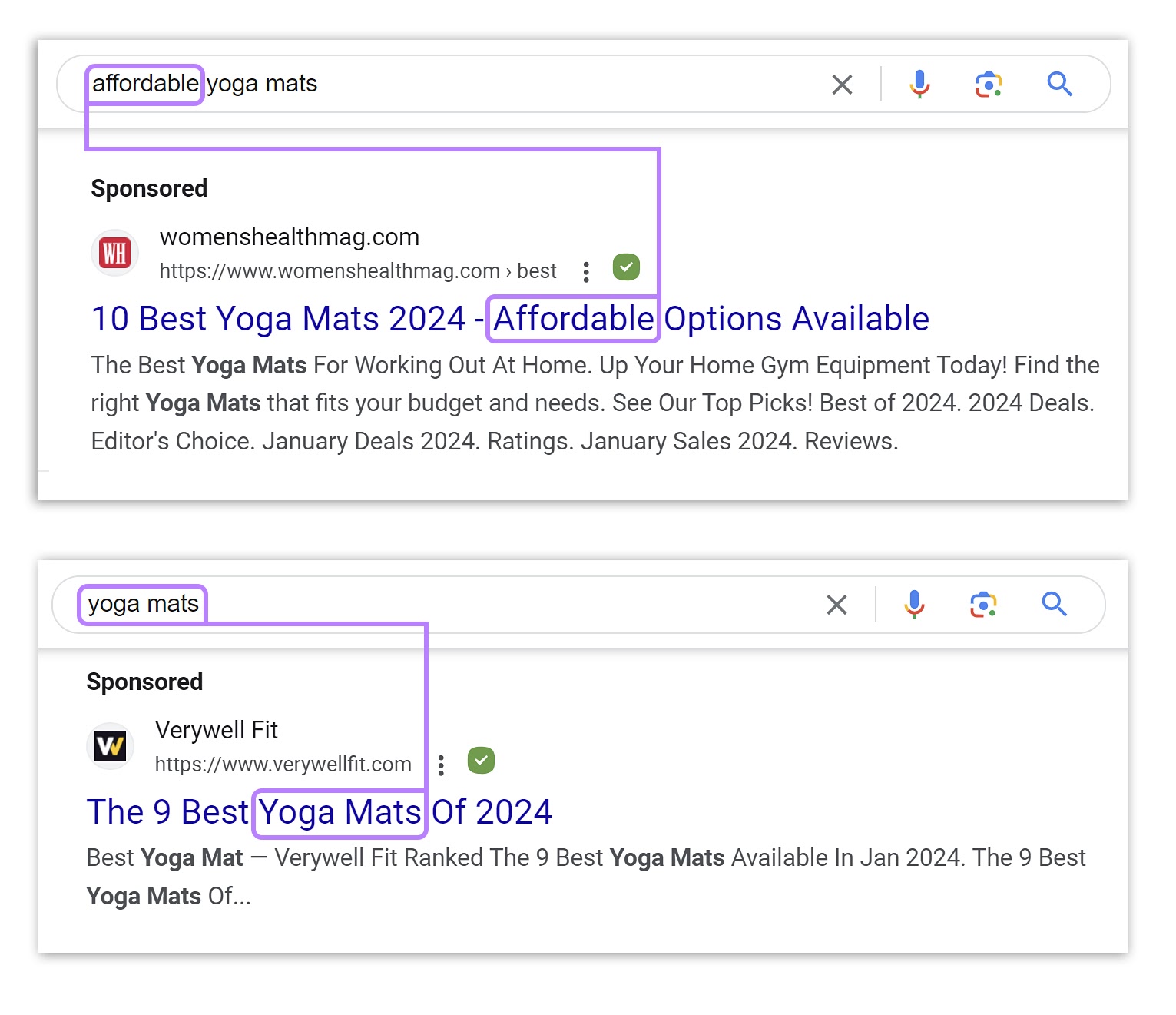
The specific terms users search for can significantly affect ad rankings. Search engines prefer ads that exactly match or closely align with the searched terms.
For example, an ad containing “affordable yoga mats” is more likely to rank higher if users search for “affordable yoga mats” rather than just the exa “yoga mats.”
Time of Day
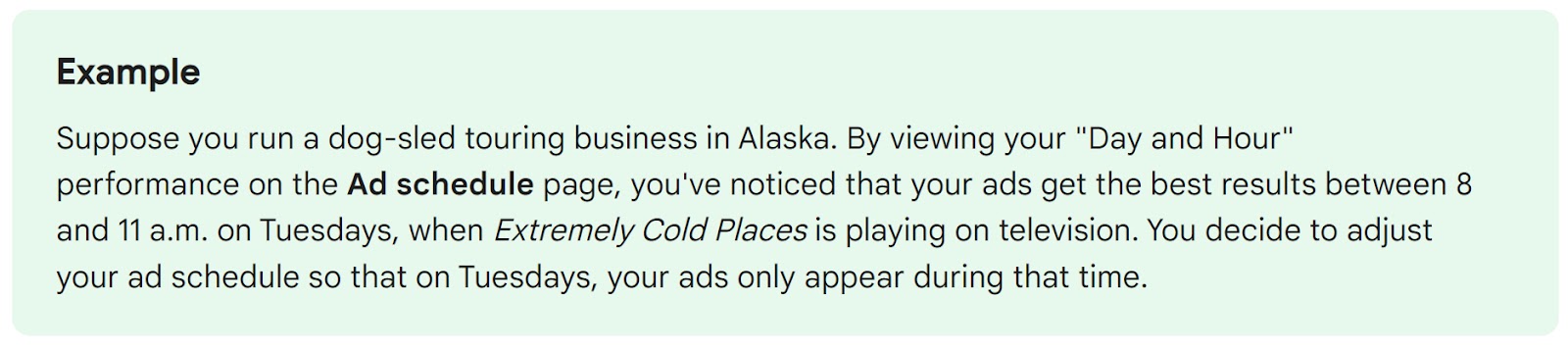
Certain ads may perform better at specific times or days of the week. For instance, ads for a breakfast restaurant are more relevant on a Saturday morning than on a Thursday afternoon.
Or this example from Google:
Location of Target Audience
Ads targeting specific locations can rank higher in those areas. If you own a flower delivery service in New York City, target people who live in or around the city if you want your ad to perform well.
All paid search ads platforms allow you to choose your target audience and location when setting up your ads.
Competing Ads/Other Search Results
Your paid search ad ranks relative to other advertisers targeting similar keywords or phrases.
If the competition for “biodegradable coffee pods” is high, your ad needs to be more optimized in bid, quality, and relevance than your competitors to rank well.
You may need to increase your keyword bid or look at ways to create a more appealing ad.
If that doesn’t work, build a new campaign around a similar, less competitive keyword like “environmentally friendly coffee pods.”
Device Type
Ads get ranked differently based on the device users view them on.
And an ad leading to a mobile-friendly landing page will likely rank more prominently in mobile search results than one that isn’t mobile-optimized.

Further reading: What Is Mobile Advertising? Types, Tips, and Examples
Paid Search Ads Best Practices
Paid search ad best practices can help you create efficient campaigns that align with your business goals and marketing budget.
Track and Optimize Return on Investment
Measuring ROI involves assessing the profitability of your ads relative to their cost.
Track metrics like CPC, cost per acquisition (CPA), and overall ad spend against the revenue generated from conversions. You can track some directly from the paid search platform you’re using.
Hover over to the “Ad” Toolkit in the left-hand navigation bar and select “PPC Keyword Tool.”
You’ll then land on the dashboard, where you can manage all your campaigns in one place.

By default, you’ll see a “Default campaign.” You can use it to get started or create a new campaign from scratch.

Add keywords manually, upload from a file, or import directly from Semrush.

Once your keywords are added, organize them into ad groups, assign match types, and set negative keywords at both the campaign and group level to improve targeting.

You’ll also be able to view key metrics for each keyword (like search volume, competition, and estimated CPC) to help you make informed decisions.
It’s easy to keep your campaign organized and budget-friendly with PPC Keyword Tool.
It can reveal which keywords drive the most profitable traffic.
You can export all your Semrush plans and upload them directly to your Google Ads account. Similarly, you can import an existing Google Ads campaign to restructure it in one place.
The key to maximizing your return on investment is to continuously optimize your ad campaign based on your analysis. If you observe that specific keywords bring in high-value customers, consider increasing your bid on those keywords.
Never stop optimizing your ad campaign based on your analysis—it’ll maximize your ROI potential.
Don’t Run on All Broad Match Keywords
While broad match keywords can increase your reach, they often attract less targeted traffic. This can lead to lower conversion rates and wasted ad spend.
Instead, use a mix of match types, including exact and phrase matches. This strategy can help you reach a more targeted audience and balance reach and relevance.
Using a phrase match for “women’s running shoes” can attract more relevant clicks than a broad match, which could trigger your ad for any search containing “women,” “running,” or “shoes.”
Focus on Outcomes, Not Activities
Shift your focus from activities (like number of clicks or impressions) to outcomes (e.g., conversions and sales). Set clear goals for what you want to achieve with your PPC campaign—such as lead generation, sales, or brand awareness.
This approach helps you make more data-driven decisions.
If your goal is to increase online sales, concentrate on keywords and phrases that have historically led to higher sales. Even if they have fewer clicks.
Calculate the Conversion Rate Required
What is the necessary conversion rate to make your campaign profitable? The answer can help you justify ad costs—so you know when to pause or add funds to your campaigns.
First, clarify the type of conversion rate you’re after. Not all conversions are quantifiable in terms of profitability.
Say you run an ad for a webinar that leads to sales and may need some nurturing in between. ROI calculations will differ from an ad where you calculate direct clicks to a product page and measure sales.
Forecast Your Likely Results Before You Begin
Before launching a paid search campaign, forecast potential results based on historical data and industry benchmarks.
Forecasting helps you set realistic goals and budgets as you observe what has and hasn’t worked. And when.
For example, if historical data shows a 2% conversion rate for similar products or services, you can estimate how much traffic you need to meet your sales goals.
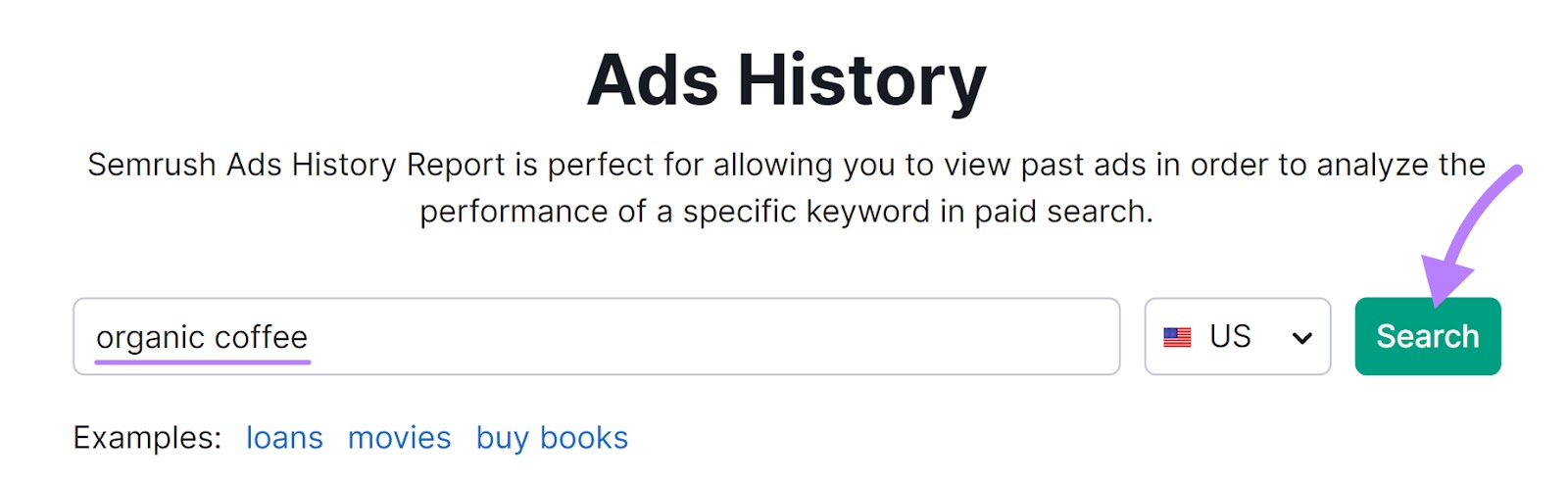
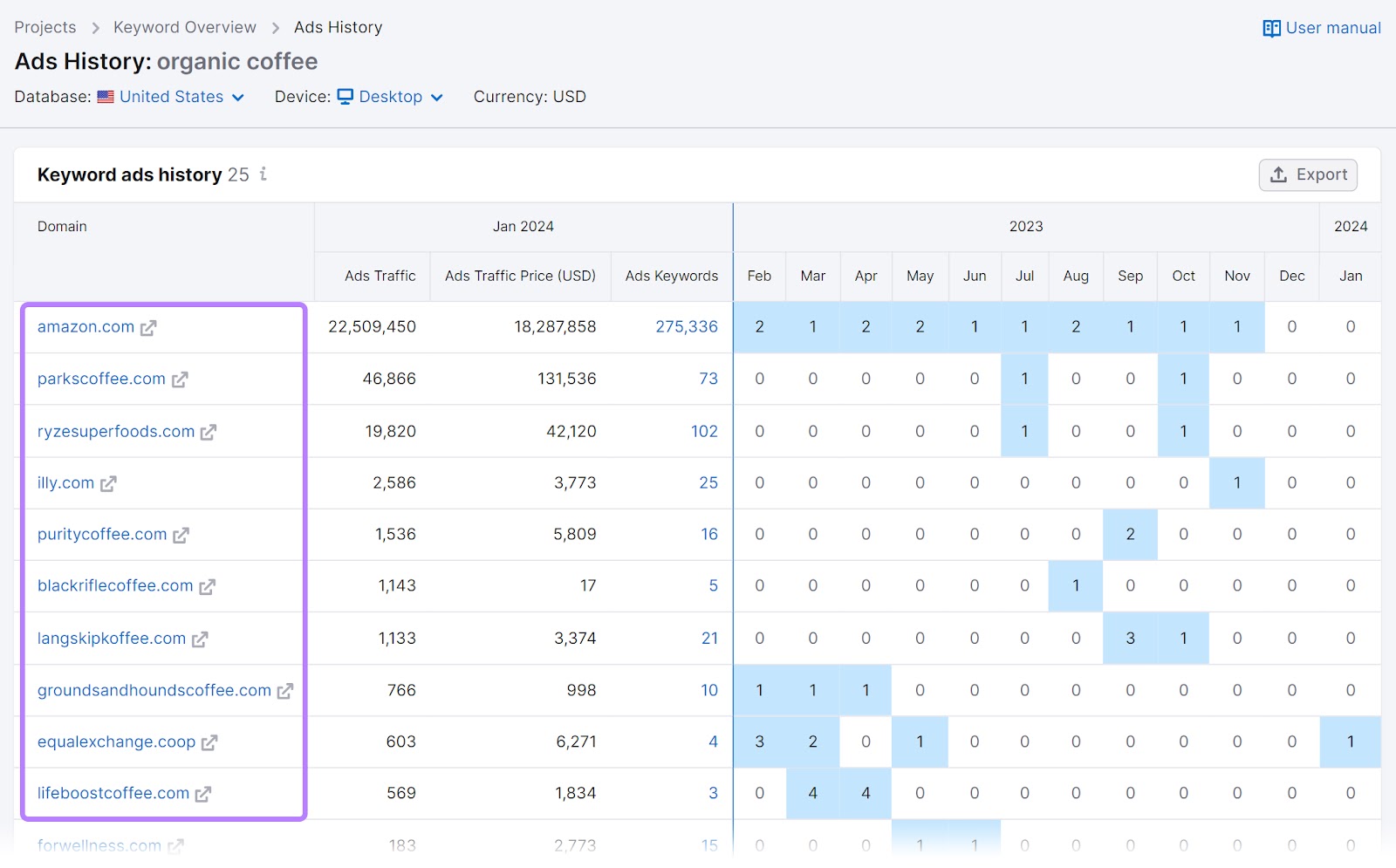
Semrush’s Ads History tool lets you view historical competitor ads to see how well a keyword has performed in paid searches.
Enter your target keyword and click “Search.”
Here, you can see which advertisers appeared in the top eight paid positions on Google’s SERPs over a 12-month period.
Optimize Your Paid Search Ads with Semrush
Remember, a successful paid search campaign is not just about outbidding competitors. It’s about crafting quality ads, targeting the right audience, and continuously refining your campaigns based on measurable outcomes.
Combine tools like Advertising Research and Keyword Magic Tool with a developed understanding of SEO, and you’ll end up with a robust search ad strategy to grow your reach and boost conversions.